
SKUs vs UPCs: Differences, Roles in Inventory Management and Which one to Use
When your business begins to grow and expand, you'll eventually come across several barcodes with various meanings and purposes. Stock-keeping Units (SKUs) and Universal Product Codes (UPCs) are prime examples of these identifiers.
These acronyms are sometimes used interchangeably by consumers and business owners alike, which is understandable given that they are both barcodes used in commerce. However, knowing the distinction is critical for small business owners and staff who handle inventory management.
What is an SKU?
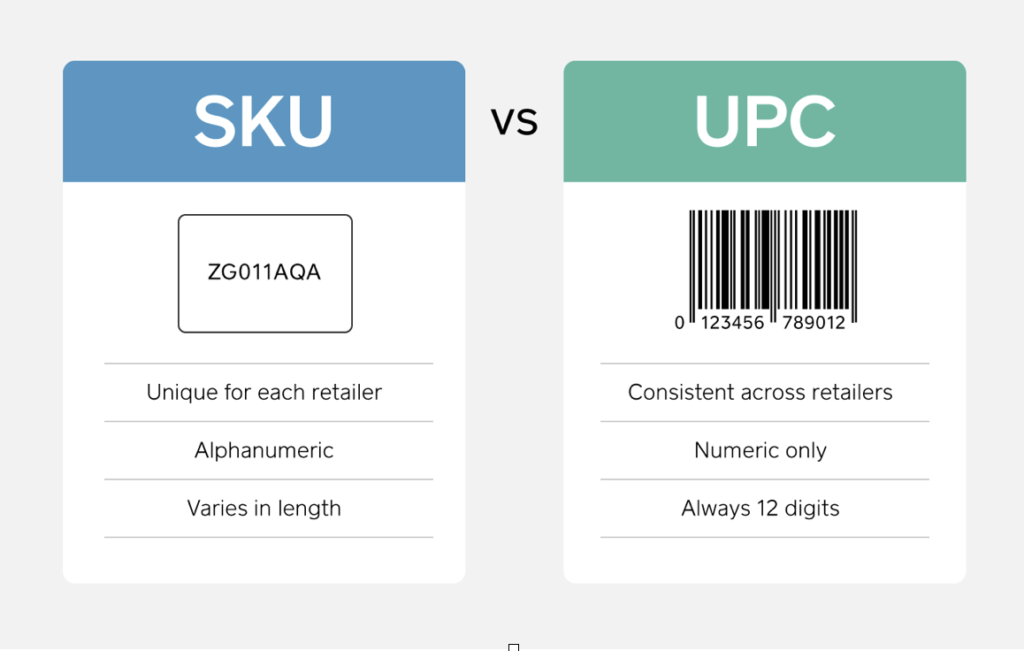
A Stock-Keeping Unit (SKU) is a unique identification code for a retail item. It's a scannable barcode most commonly found on product labels at a store. The SKU is an alphanumeric code that allows businesses to maintain inventory, measure sales by product and category, map out store layouts, and improve the overall customer experience.
Retailers create these codes internally depending on characteristics that are significant to them, establishing variations based on specific product aspects. SKUs are usually divided into classifications and categories. For example, a clothing store might have sections like adult wear or children's wear, and their SKUs might be organized by numbers or letters to designate specific product categories within those areas. This tracking layout allows vendors to monitor inventory movement in real-time.
What is a UPC?
A UPC (Universal Product Code) is a standardized product identifier used across retail systems to uniquely identify products worldwide. It offers a simple, globally effective way to keep track of product information and distribution.
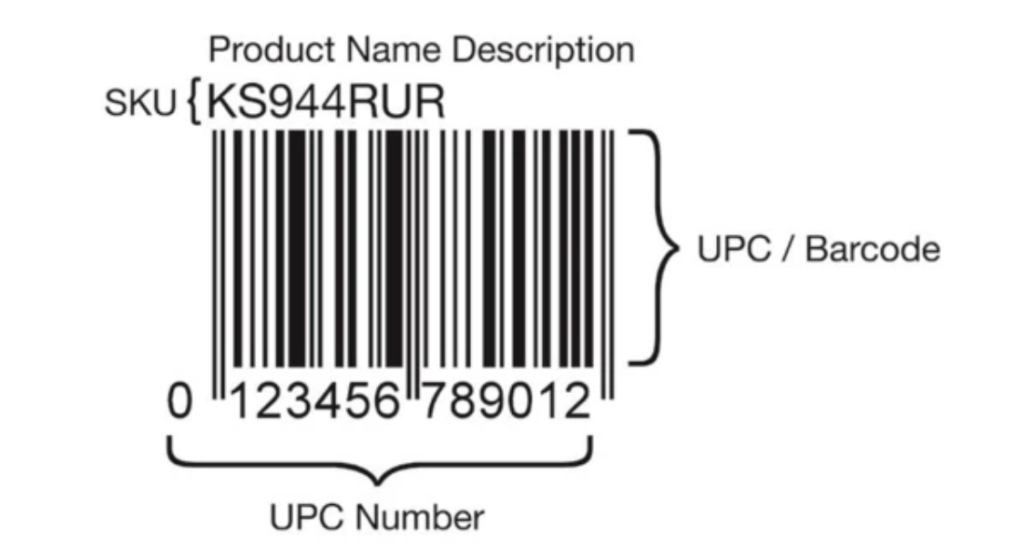
The UPC barcode is composed of two distinct parts: the machine-readable barcode (the series of unique black bars) and the standardized 12-digit number underneath it.
Difference Between SKUs and UPCs
| SKU | UPC |
|---|---|
| Companies can establish their own SKU numbers at their leisure. | GS1 is in charge of administering and issuing official UPCs. |
| The length of SKU numbers is determined internally by the company. | It is a fixed-length string of numbers. |
| They are created by the businesses that use them internally. | UPC barcodes are universally recognized and stay consistent worldwide. |
| SKUs are alphanumeric codes (can contain letters and numbers). | UPC barcodes must have a total of exactly 12 digits. |
| Individual retailers control their own unique SKU structures. | UPC barcodes are printed directly onto universal product packaging. |
| Physical objects and intangible services can both utilize SKUs. | They are exclusively used for physical retail goods. |
| They can be printed locally on retailer tags and store shelf labels. | It is mandatory to formally obtain and license official UPC barcode numbers. |
Role of SKUs and UPCs in Inventory Management

Generally, companies of all sizes face major inventory tracking challenges. Thousands of square feet of space can be filled with shelved items in warehouses and distribution hubs, bringing unique bottlenecks—such as knowing exactly what comes in and goes out, identifying top-performing vs. stagnant items, and verifying product expiration variables.
The location of goods becomes immediately transparent using a structured barcode system. UPCs and SKUs work together to monitor a product from initial receipt to shipping, shelving, and checkout. This helps verify that the number of products ordered matches the quantity received, especially in large shipments containing hundreds of units. If shrinkage is an issue, this historical data can pinpoint exactly where in the supply chain products are going missing.
The Importance of SKUs
SKUs are vital because they allow merchants to collect granular data that maps product popularity or monitors seasonal and cyclical sales trends within client demographics.
Retailers can also manage inventory levels, turnover speed, and shelf flow using singular SKUs. By tracking sales trends, businesses can establish programmatic triggers for launching or halting new inventory reorders.
Furthermore, floor staff can scan an SKU to rapidly check stock availability for a customer who may be looking for a different size or color variant, drastically improving sales efficiency and customer satisfaction.
In a competitive online landscape where consumers constantly price-shop, a tailored SKU structure ensures your internal inventory remains unique, letting you isolate specific marketing strategies that drive individual conversions.
SKU vs UPC: Which Should You Use?
Where you sell your items and the functional workflows you wish to achieve dictate whether you require UPCs, SKUs, or both. Most of the time, sellers, vendors, and distributors use both in tandem—assigning a universal UPC and a custom SKU for every single item. Amazon, for example, requires a UPC alongside an SKU for each live listing.
As a rule of thumb, SKUs are utilized internally, while UPCs are recognized externally.
Use an SKU when you wish to:
- Reflect the most significant qualities of your products by embedding color, style, brand, type, size, and pricing info.
- Instantly see how many physical units of a given item variant you have on hand.
- Perform manual price and inventory lookups when a barcode scanner isn't available.
- Pinpoint and keep track of precise inventory shrinkage.
- Organize your stockroom, fulfillment center, or warehouse layout logically.
- Cross-check physical receipts against inbound deliveries to verify order quantities.
- Generate granular internal sales reports based on custom variables.
- Automate reordering thresholds and replenishment reminders.
Use a UPC when you wish to:
- Ensure accurate product monitoring as items move externally through global supply chains.
- Make your items natively compatible with standardized commercial retail point-of-sale software.
- Expand your distribution network onto major marketplaces like Amazon or into big-box retailers like Walmart.
The core distinction is that SKUs are internal and flexible, whereas UPCs are external and static. Each plays a distinct role, but they operate together to make your item tracking seamless.
Best Platforms to Automate SKU and UPC Management
A full-featured POS system will allow you to manage and track all of your SKUs and UPCs in one place, synchronized across all of your store locations and digital sales channels. Automating this layout gives you access to real-time restock warnings and advanced analytics reporting.
- Lightspeed POS: A feature-rich solution built for handling massive inventory bases. It smoothly manages up to 10,000 SKUs alongside product variations, bundles, and item kits. SKUs and UPCs can be manually logged or imported via spreadsheets.
- Square for Retail: When adding new items in the Square Dashboard, you can type in or auto-generate custom product SKUs. You can print barcode labels right from your dashboard and import legacy UPC data instantly using a CSV upload.
- Clover: This platform offers dedicated data fields for both SKU and UPC variants, linking seamlessly with "Easy Labels"—a top external integration for customizing and printing barcode sticker labels.
- Shopify: Shopify utilizes native applications like SKUGen to generate, manage, and print barcodes. You can attach global UPC codes to items in bulk via CSV or modify them line-by-line in the dashboard.
While UPCs are rigid and provide less flexibility, you'll want to establish a scaling naming strategy for your internal SKUs that protects your workflow as your product catalog expands.
UPCs.com is the leading authority for official, online UPC acquisition. You can order official UPC codes from us in seconds. Whether you're selling at a local boutique, scaling on Amazon, or preparing your supply chain logistics, we are here to support your growth. Remember: SKUs can be modified anytime down the line, but your UPC stays locked to that product item forever.
Have any questions about getting your inventory retail-ready? Let us know, we are glad to help!