
Barcode Label Materials: Paper vs. Film, Direct Thermal vs. Thermal Transfer
A barcode label only has one job: scan every time, for as long as the product is on a shelf or in a warehouse. Yet labels fail all the time — they fade in a sunny window, smear in a bathroom, curl off a cold bottle, or peel off in the freezer. The barcode was fine; the label was wrong for where it lived. So which barcode label material should you use?
The direct answer: for dry, indoor products, a standard matte paper label is all you need. For anything wet, oily, cold, or meant to last for years, choose a synthetic film label with an adhesive rated for the conditions, printed with thermal transfer or professional printing — never direct thermal. Below is a quick-reference table, the difference between the print methods, and how to test a label before you commit.
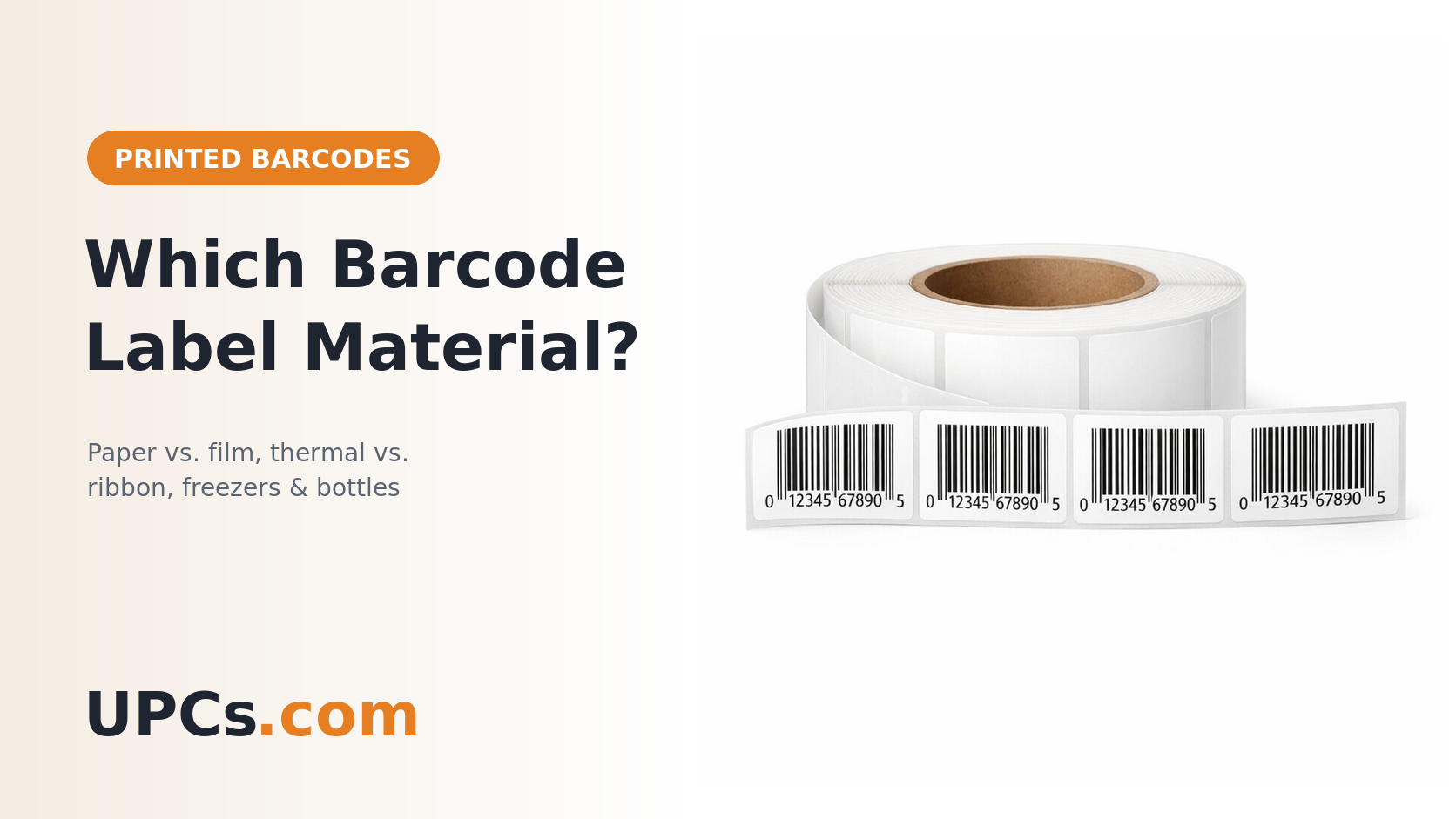 The right label depends on where your product lives: shelf, bathroom, fridge, or warehouse.
Quick Reference: Which Label for Which Product?
| Where the Product Lives | Label Material | Adhesive | Print Method |
|---|---|---|---|
| Retail boxes, bags, hang tags (dry, indoors) | Matte paper | Permanent | Any |
| Bath and beauty, bottles, anything wet or oily | Film (polypropylene or polyester) | Permanent | Thermal transfer or professional print |
| Refrigerated and frozen | Film or freezer-grade paper | Freezer or all-temperature | Thermal transfer or professional print |
| Warehouse stock kept for months or years | Paper or film | Permanent | Thermal transfer or professional print |
| Shipping labels (days to weeks) | Direct thermal paper | Permanent | Direct thermal |
Direct Thermal vs. Thermal Transfer (and Office Printers)
How the barcode gets onto the label matters as much as the label itself:
- Direct thermal: the printer heats special heat-sensitive paper, which darkens. There's no ink or ribbon, so it's cheap and simple — which is why it's used for shipping labels. The catch: the print fades with heat, sunlight, and time, and it scratches easily. Don't use it for product barcodes that need to last.
- Thermal transfer: the printer melts ink from a ribbon onto the label. The result lasts for years. Wax ribbons suit paper labels, wax-resin is a good all-rounder, and resin ribbons are the toughest choice for film labels exposed to water, oils, or rubbing.
- Laser and inkjet sheets: handy for small batches on an office printer. Laser toner holds up well; inkjet ink can smear when wet unless you use waterproof label stock. (How-to: printing barcode labels at home.)
- Professionally printed labels: no printer to buy, no ribbons, and consistent print quality from the first label to the thousandth. (Cost comparison: pre-printed labels vs. DIY printing.)
Adhesive: The Part Nobody Thinks About
- Permanent: the standard for product labels. It won't come off cleanly — which is the point.
- Removable: peels off without residue. Useful for gifts and resale items, but not for barcodes that must stay put.
- Freezer or all-temperature: designed to stick in the cold. Standard adhesive can lose its grip below freezing.
- High-tack: for textured, rough, or tightly curved surfaces.
Whatever you choose, apply labels to a clean, dry surface at room temperature and press them down firmly. Many adhesives take up to a day to reach full strength, so label products before they go into cold storage or shipping boxes.
Finish, Curves, and Small Products
- Matte beats gloss. A glossy finish can reflect store lights straight back into the scanner.
- Film bends better than paper. On small bottles and tubes, a flexible film label follows the curve without wrinkling or lifting.
- Turn the barcode on narrow curves. Rotate it 90° so the bars run around the bottle rather than across the curve. (Artwork specs: barcode files for packaging designers.)
- Leave room for a full-size code. A standard UPC needs a label of about 1.5" × 1" or larger. (Choosing a format: rolls vs. sheets.)
Step-by-Step: Choosing and Testing Your Label
-
1
Describe Where the Product Lives
Shelf, bathroom, fridge, freezer, outdoors, or warehouse? Wet, oily, or handled a lot? Write it down — it decides everything else.
-
2
Decide How Long the Label Must Last
Days (shipping) is a different job from years (retail stock). Anything longer than a few weeks rules out direct thermal.
-
3
Match Material and Adhesive to the Surface
Paper for dry, flat surfaces; film for wet, oily, or curved ones; freezer adhesive for cold.
-
4
Pick How You'll Print
Print yourself on blank rolls or blank sheets, or have us print them: our printed barcode labels come on rolls or sheets of 1,000 in several sizes and ship within 24 hours in the US. Need a size or label that isn't listed? Use the form on the Printed Barcode Labels page and tell us where the labels will be used.
-
5
Torture-Test a Sample
Put a labeled product through its real life: a night in the freezer, a wipe with the product's own lotion or oil, a week on a sunny windowsill. Then scan it. (If it fails: why won't my barcode scan?)
Frequently Asked Questions
How long do direct thermal labels last?
It depends on heat and light, but they can start to fade within months. Use them for shipping, not for product barcodes that sit on shelves or in storage.
Are paper barcode labels waterproof?
No. Water and oils soak into paper and can blur the print or lift the label. Use a film label for anything that gets wet.
What label should I use for frozen products?
A label with a freezer or all-temperature adhesive, applied before the product goes into the freezer, printed with thermal transfer or professional printing.
Matte or glossy barcode labels?
Matte. Glossy finishes can reflect light back into the scanner and cause missed scans.
Barcode Labels, Printed and Shipped
Printed UPC labels on rolls or sheets, shipped within 24 hours — or blank labels to print yourself. Tell us where they'll be used and we'll help you choose.
Shop Barcode Labels