
Does a Barcode Tell You Where a Product Was Made? The Country-Code Myth
Every year or two, the same post goes viral: "Check the first three digits of the barcode! If it starts with 690–699, the product was made in China. Buy 00–09 to support American manufacturing!" It gets shared millions of times, usually with a helpful-looking chart attached. And it sounds so plausible — the numbers are right there on the package.
Here's the direct answer: No, a barcode does not tell you where a product was made. The first digits of an EAN barcode identify the GS1 member organization where the company registered its numbering prefix — not the factory where the product was manufactured. A brand registered in the United States can manufacture everything in China, Vietnam, or Mexico and still carry a "US" prefix. The only reliable indicator of origin is the "Made in ___" label, which customs law requires on imported goods.
As the manager at UPCs.com, I get asked about this constantly — by shoppers who saw the viral chart, and by sellers worried their barcode will "say the wrong country." Let's break down what those digits actually mean, where the myth came from, and how to genuinely check a product's origin.
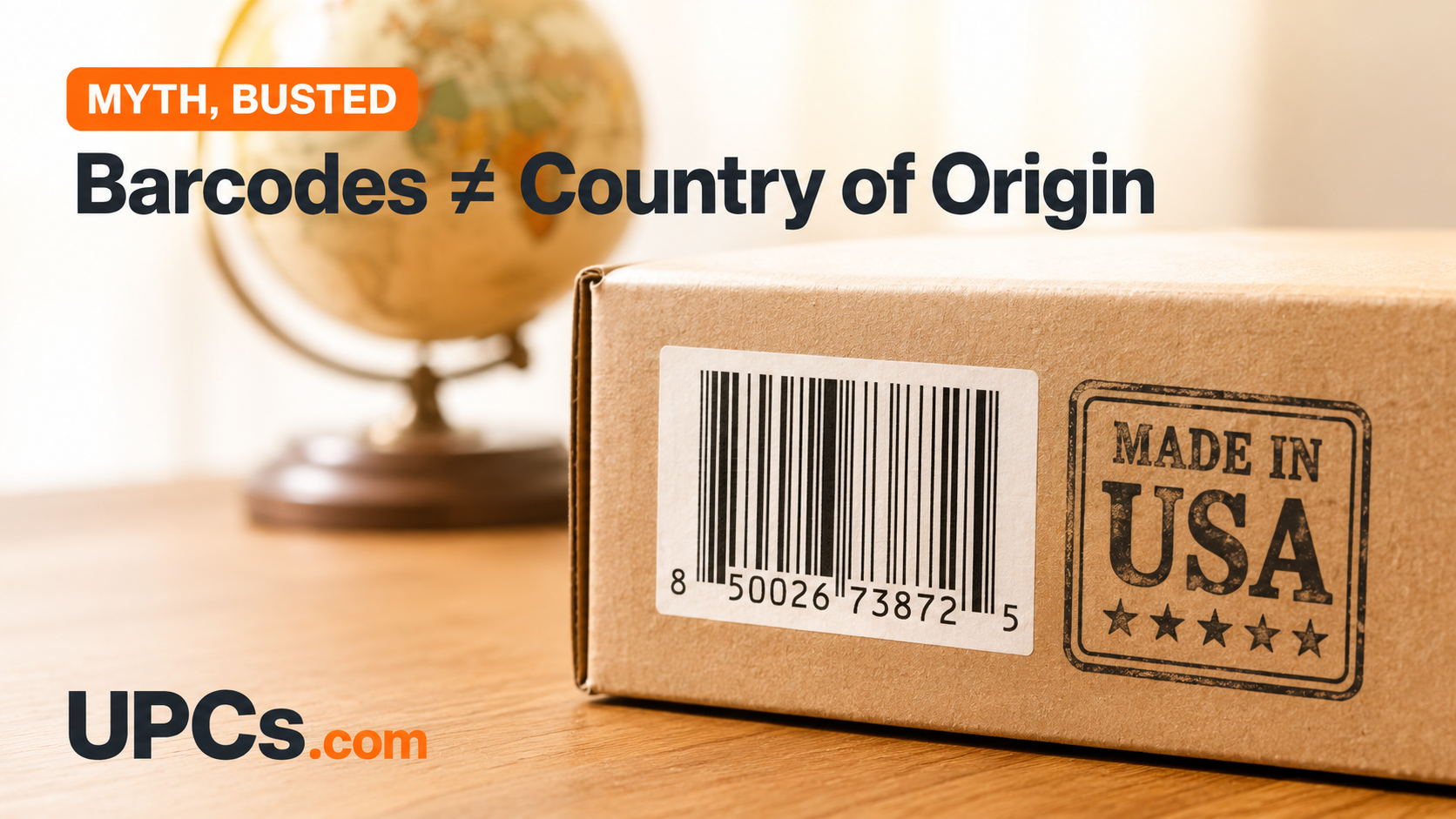 The barcode prefix tells you where a company registered — the "Made in" label tells you where the product was made.
What Do the First Digits of a Barcode Actually Mean?
The 13-digit EAN barcodes used worldwide begin with a GS1 prefix — a number range assigned to each national GS1 member organization. When a company joins GS1 (or buys legacy codes), its company prefix begins with the digits of the organization that issued it.
That's it. The prefix records an administrative fact — which office issued the number — the same way a phone number's area code tells you where the line was registered, not where the caller is standing right now.
Think about how global commerce actually works: an American brand designs a product in California, manufactures it in Shenzhen, and sells it in 40 countries — all under one barcode starting with 0. A German company can register with GS1 Germany (prefix 400–440) and produce everything in Poland. The prefix never changes based on the factory. (Related reading: GTIN vs. UPC — what barcodes actually encode.)
Common Prefix Ranges — and What They Really Tell You
| EAN Prefix | Issuing Organization | What the Myth Claims | The Reality |
|---|---|---|---|
| 000–139 | GS1 US (UPC range) | "Made in USA/Canada" | Company registered through the US system — product could be made anywhere |
| 300–379 | GS1 France | "Made in France" | Company registered in France |
| 400–440 | GS1 Germany | "Made in Germany" | Company registered in Germany |
| 450–459, 490–499 | GS1 Japan | "Made in Japan" | Company registered in Japan |
| 690–699 | GS1 China | "Made in China" | Company registered in China — many export brands manufacture elsewhere too |
| 930–939 | GS1 Australia | "Made in Australia" | Company registered in Australia |
Notice the pattern: every row is about the company's registration, never the product's manufacturing site. GS1 itself has publicly debunked the country-of-origin interpretation for exactly this reason.
What About 12-Digit UPC Codes?
Here in North America, most products carry the 12-digit UPC rather than the 13-digit EAN. UPC codes don't carry a country prefix at all in the popular sense — the first digit is a number system character (0 for regular products, 3 for pharmaceuticals, 5 for coupons, and so on). When a UPC is converted to EAN-13 format, a leading zero is added, which is why UPC products appear to have "US" prefixes. It's a formatting artifact, not a passport stamp. (More on structure: how many digits are in a UPC code?)
This is also worth knowing as a seller: the same product sells globally with the same code, whether formatted as UPC or EAN.
How to Actually Check Where a Product Was Made
-
1
Read the "Made in" Label
US customs law (and equivalent laws in most countries) requires imported goods to be marked with their country of origin. This label — not the barcode — is the legally accountable statement of where the product was made.
-
2
Check the Packaging Fine Print
Look for "Manufactured for..." or "Distributed by..." statements. These often reveal the brand's home country and the manufacturing origin separately — which is exactly the distinction the barcode myth collapses.
-
3
Look Up the Barcode's Registered Owner
A UPC lookup can tell you which company a code is registered to — useful for verifying a brand, but remember it identifies the company, not the factory. (How lookups work: how do I look up a UPC code?)
Why This Myth Matters for Sellers
If you're a brand owner, the myth cuts the other way: sellers sometimes worry that buying barcodes will make their product "look foreign" or that they need codes "registered in their country." Neither is true. Retail scanners and marketplace systems read your code as a product identifier, full stop — no shopper-facing country flag is attached. (We bust more of these in the Top 12 Myths About UPC Barcodes.)
What does matter is that your codes are authentic and owned outright. GS1 sells prefixes on a subscription — setup fees plus renewals every year, forever. At UPCs.com, you buy legacy codes once and own them for life, and they scan identically in every store and marketplace on earth. (Cost breakdown: how much are UPC codes?)
Frequently Asked Questions
Does a barcode starting with 690 mean the product was made in China?
No. It means the company that registered the barcode prefix did so through GS1 China. The product itself could be manufactured in China or anywhere else — and products with US prefixes are frequently made in China too. Check the "Made in" label for actual origin.
Can I choose a barcode prefix that shows my country?
You don't need to. The prefix is an administrative artifact that shoppers never see interpreted at checkout. One code works worldwide — US sellers typically use the 12-digit UPC, and international retailers accept it as an EAN with a leading zero.
Why does a different company name come up when I scan my product?
Legacy codes remain registered to the original prefix holder in public databases — that's normal and doesn't affect scanning or listing. (Full explanation: why isn't my company name coming up when scanned?)
Is there any barcode that does encode the country of manufacture?
Standard retail barcodes (UPC/EAN) do not. Newer 2D formats can carry extra data like batch numbers and expiry dates, but country of manufacture still lives on the label, not in the symbol. (Curious about those formats? See 2D barcodes explained.)
Barcodes That Work Everywhere
Authentic UPC codes delivered to your inbox in minutes — one low price, owned forever, accepted by retailers and marketplaces worldwide.
Buy UPC Barcodes Now