
Barcodes for Supplements and Vitamins: UPC, FDA Labeling, and Amazon Requirements
Supplements are one of the most profitable — and most paperwork-heavy — categories in e-commerce. Between FDA labeling rules, Amazon's gated category requirements, and co-manufacturer specs, new supplement founders face a wall of acronyms. And somewhere in that wall sits a deceptively simple question: what kind of barcode does my supplement need?
The direct answer: your supplement needs one standard 12-digit UPC code per unique product — every formula, flavor, and count size gets its own code. The UPC has nothing to do with the FDA, doesn't require any registration with a government agency, and can be purchased and in your inbox within minutes. As the manager at UPCs.com, I've set up barcodes for hundreds of supplement brands, and the confusion is almost always the same — so let's untangle the UPC from the FDA panel first, then walk through Amazon's requirements and exactly how many codes you need.
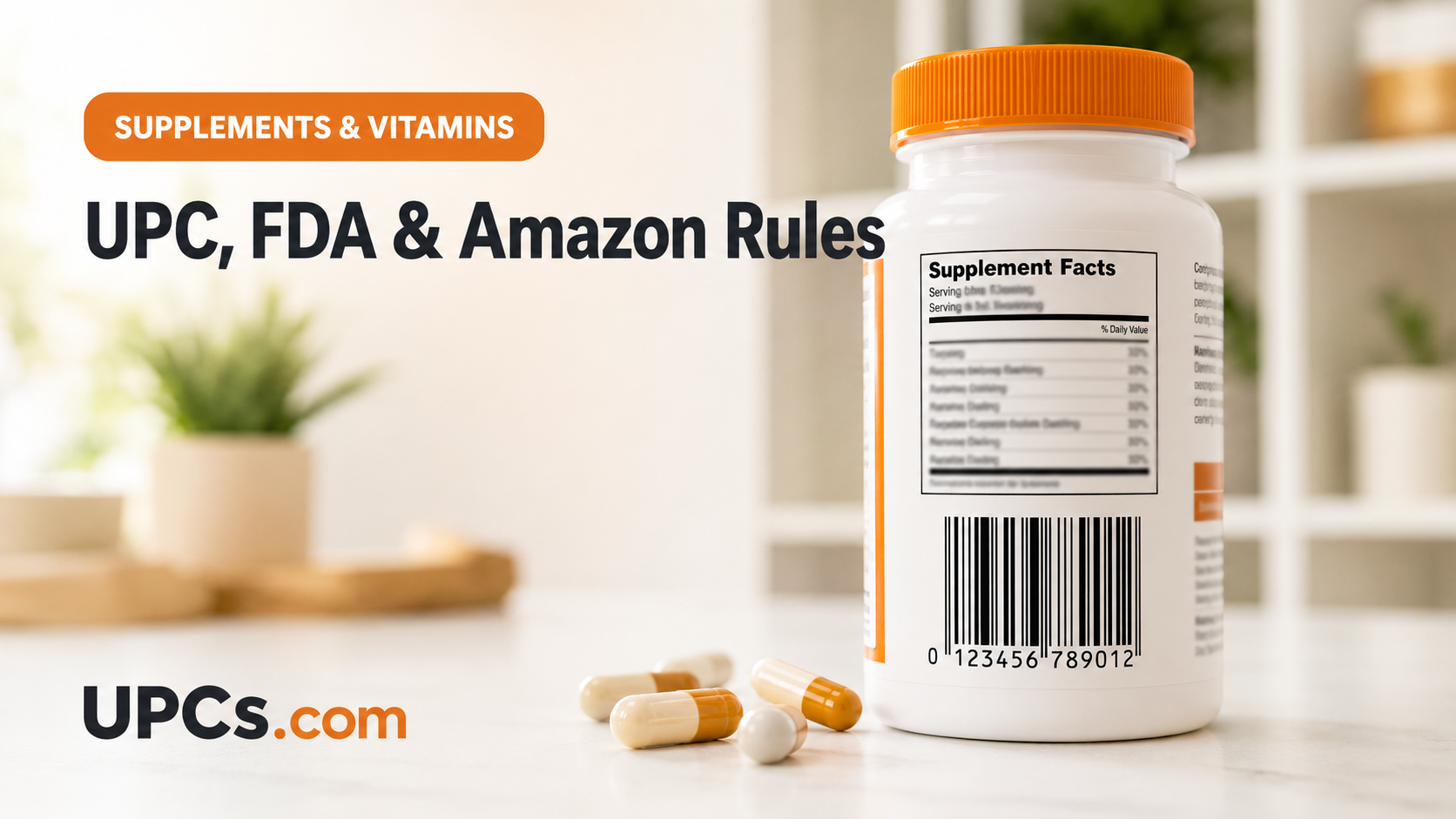 Two different jobs on one label: the FDA regulates the Supplement Facts panel; the UPC simply identifies the product.
UPC vs. FDA: Who Regulates What on Your Label?
This is the single biggest misconception we hear from supplement founders: that a UPC is some kind of FDA registration, or that the FDA issues barcodes. Neither is true. They occupy completely separate lanes:
| Label Element | Who Governs It | What It Does |
|---|---|---|
| Supplement Facts panel | FDA (21 CFR 101.36) | Discloses serving size, ingredients, and daily values |
| Structure/function claims & disclaimer | FDA / FTC | Regulates what you can say the product does |
| Net quantity, manufacturer info | FDA | Required identity and contact statements |
| UPC barcode | Commerce standard — not a government agency | Identifies the product at registers and marketplaces |
In other words: the FDA cares deeply about your Supplement Facts panel and doesn't care at all about your barcode. The UPC exists so that Amazon, Walmart, GNC's registers, and your 3PL's scanners all agree on exactly which bottle is which. Buying a UPC involves no application, no approval, and no waiting — order at UPCs.com and the codes arrive by email within minutes. (New to the terminology? Start with GTIN vs. UPC explained.)
Amazon's Requirements for Supplement Listings
Amazon treats dietary supplements as a gated category: before you can list, you'll go through category approval — product images, ingredient labels, and often a Certificate of Analysis (CoA) from your manufacturer. Two barcode-related facts matter here:
- A valid UPC is required for every listing. Supplements rarely qualify for GTIN exemptions — Amazon wants branded, identifiable products in this category, and your UPC is how they anchor your listing to your brand. (The full picture: Amazon FBA UPC requirements explained.)
- Your UPC must be on the physical label shown in your compliance images. Amazon's review compares the barcode in your listing data to the bottle photos you submit, so assign your codes before your label designer finalizes artwork.
Don't be tempted by free online barcode generators — a generator draws an image but can't issue you a legitimate number, and Amazon validates codes at listing time. Invalid or recycled numbers are how sellers end up buried in GTIN mismatch errors.
How Many UPCs Does a Supplement Line Need?
One per unique sellable item. For supplements, "unique" is defined by three things — formula, flavor, and count/size:
- Whey protein in Chocolate and Vanilla → 2 UPCs
- Each of those in 1 lb and 5 lb tubs → 4 UPCs
- A 60-count and a 120-count of the same capsule → 2 UPCs
- A bundle (e.g., "Immunity Stack" of three bottles sold as one unit) → its own UPC
One honest nuance that saves founders money: a minor formula revision doesn't automatically require a new UPC. If you tweak an excipient or refresh the label design but the product keeps the same name, count, and market position, it keeps its code. But a new flavor, a new count size, or a reformulation you're marketing as a distinct product ("Extra Strength") is a new item — new UPC. (The complete rule set: Do I need a separate UPC for every product?)
Step-by-Step: Barcoding Your Supplement Brand
-
1
Map Your SKUs Before Label Design
List every formula × flavor × count combination, plus planned bundles. Assign an internal SKU to each row. (SKU vs. UPC roles: here's the difference.)
-
2
Buy Your UPCs — Once, Not Annually
Order your block at UPCs.com. You'll receive the numbers, scan-ready barcode graphics, and a certificate of ownership within minutes — and unlike GS1's subscription model (setup fees plus renewals every year, forever), these codes are a one-time purchase you own for the life of your brand. On supplement margins, recurring overhead compounds fast. (Comparison: GS1 vs. non-GS1 barcodes.)
-
3
Place the Barcode Into Your Label Artwork
Send the barcode graphic to your label designer along with your Supplement Facts panel. On narrow bottles, rotate the barcode 90° into "ladder" orientation — bars horizontal, running around the bottle's circumference — so the curve doesn't distort the bar widths. Keep the quiet zones clear, and never print bars in light colors. (Specs: barcode sizing and placement.)
-
4
Sync the Codes Everywhere
Enter the same UPC in your Amazon listing, Walmart item setup, Shopify variant barcode field, and your co-manufacturer's spec sheet. If retail is in your plan, add SCC-14 case codes for master cartons so distributors can receive by the case.
-
5
Verify Before the Print Run
Scan a printed proof with a phone app and confirm the code resolves to the right SKU in your sheet. Label reprints on 10,000 bottles hurt; a 30-second test scan doesn't. (Also: common printing mistakes to avoid.)
Frequently Asked Questions
Does the FDA require a barcode on supplements?
No. The FDA requires the Supplement Facts panel, ingredient disclosures, and identity statements — but barcodes aren't part of FDA regulation. The UPC is a commerce requirement driven by retailers and marketplaces, not the government.
Do I need a new UPC for each bottle count?
Yes. A 60-count and a 120-count are different products to every scanner and marketplace — each needs its own code. Same for each flavor of the same formula.
Will UPCs from UPCs.com work for Amazon's supplement category?
Yes — they're authentic UPCs that pass Amazon's listing validation, and we include documentation (certificate of ownership, plus a Letter of Affiliation on request) if brand verification questions ever come up. (More: where our codes can be used.)
Do my UPCs expire if I pause my brand?
Never. Your codes are yours for life — no renewals, no lapsing prefix, no re-buying your catalog after a slow year. (Details: Will my UPC codes ever expire?)
Launch Your Supplement Brand Right
Authentic UPC codes delivered in minutes — assign them before your label run and clear Amazon's gated category without barcode headaches. One price, owned forever.
Buy UPC Barcodes Now