
Do You Need Both a UPC and an EAN? Selling in the US and Europe Explained
You're gearing up to sell your product in the United States and in Europe — maybe launching on Amazon.com and Amazon.de at the same time. And every guide you read seems to say something different: "Americans use UPCs, Europeans use EANs." So do you have to buy two sets of barcodes for the same product?
Here's the short answer: In most cases, no — one UPC covers you worldwide. A UPC and an EAN aren't two different identities for your product; they're two formats of the same global numbering system. Your 12-digit UPC, with a zero placed in front of it, is its own 13-digit EAN. Modern scanners and marketplaces on both sides of the Atlantic read both.
At UPCs.com, we talk to sellers every week who nearly bought their codes twice. Let's walk through how the two formats actually relate, where a single UPC is all you need, and the specific situations where buying a dedicated EAN genuinely makes sense.
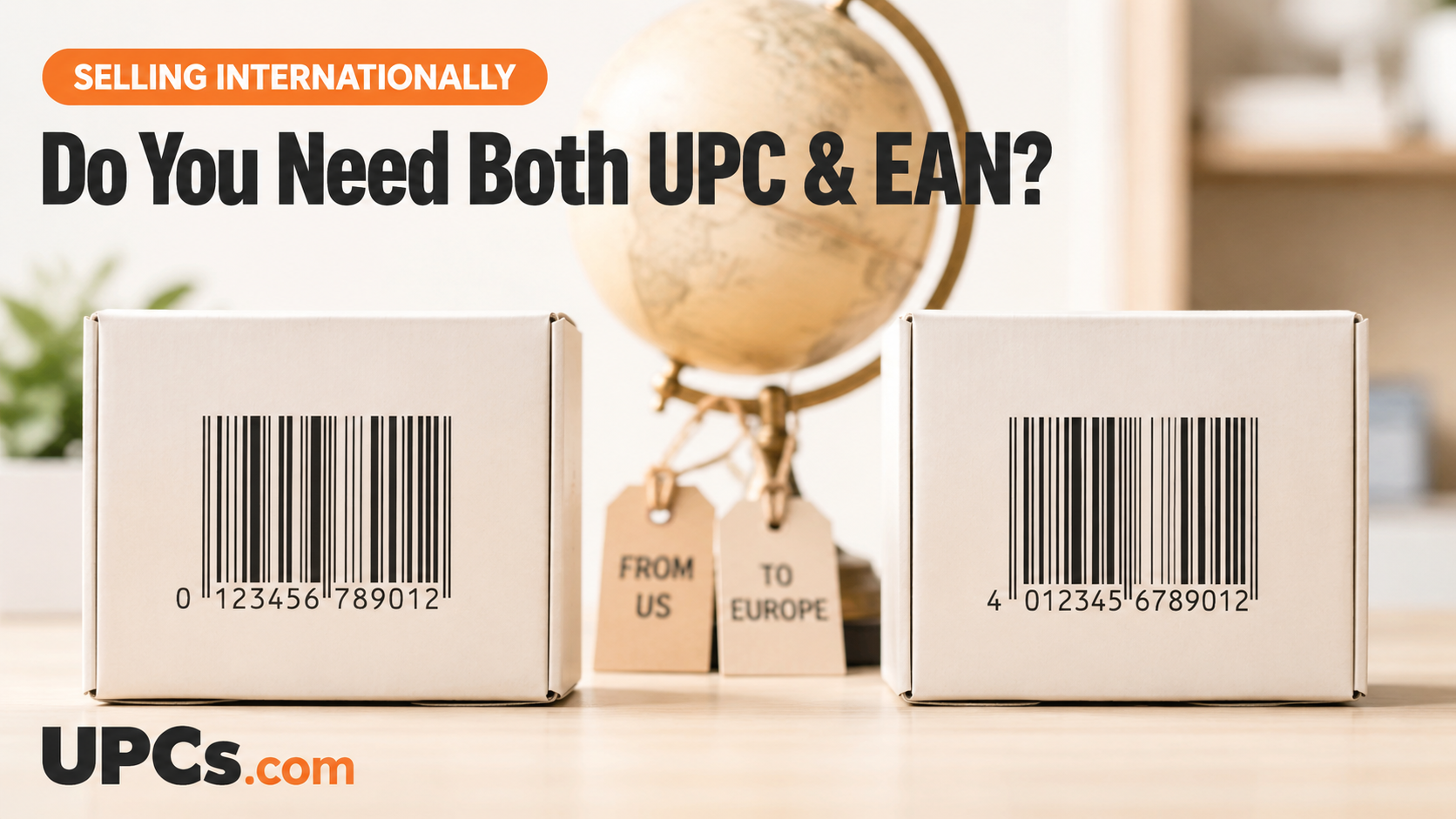 The same product number: a 12-digit UPC (US) and its 13-digit EAN form with a leading zero (Europe).
UPC vs. EAN: What's Actually Different?
Both codes are GTINs — Global Trade Item Numbers — from the same worldwide system. (Full primer: GTIN vs. UPC explained.)
- UPC (UPC-A / GTIN-12): 12 digits. The native retail standard of the United States and Canada. (Digit anatomy: how many digits are in a UPC code?)
- EAN (EAN-13 / GTIN-13): 13 digits. The standard used across Europe and most of the rest of the world.
Here's the key relationship most sellers never get told: every UPC is already an EAN. Pad your 12-digit UPC with a leading 0 and you have its exact GTIN-13 form. The barcode bars themselves are compatible — an EAN-13 symbol encoding "0 + your UPC" scans identically to your UPC-A symbol. Since 2005, retail systems worldwide (under the "Sunrise" initiative) have been required to handle both.
| UPC (GTIN-12) | EAN (GTIN-13) | |
|---|---|---|
| Digits | 12 | 13 |
| Home market | US & Canada | Europe & most of the world |
| Scans in the US? | Yes | Yes (modern systems) |
| Scans in Europe? | Yes (as 0 + UPC) | Yes |
| Amazon accepts it? | Yes — all marketplaces | Yes — all marketplaces |
| Bottom line | Same system. One UPC covers both formats for nearly every seller. | |
When One UPC Is All You Need
For the overwhelming majority of sellers, a single UPC from UPCs.com handles every channel:
- Amazon — US and international. Amazon's listing form accepts your 12-digit UPC on Amazon.com, Amazon.co.uk, Amazon.de, and the rest. The product ID field takes UPCs and EANs interchangeably because Amazon's catalog runs on GTINs. (See the 2026 Amazon UPC buying guide.)
- eBay, Etsy-adjacent stores, Shopify, Google Shopping. All GTIN fields, all format-agnostic.
- Physical retail in North America. UPC-A is the native standard.
- Most physical retail abroad. European registers read your UPC as its 13-digit form (leading zero) without any action from you.
One product, one number, every market. That's the entire point of a global trade item number — and it's why buying the same identity twice is usually wasted money.
When You Actually Need a Dedicated EAN
There are real cases where a separate EAN purchase earns its keep:
1. A European retailer explicitly requires a 13-digit code that doesn't start with 0
Some European retail chains, distributors, and older inventory systems ask suppliers for a "native" EAN-13 — a 13-digit number with a non-zero country prefix. If a buyer's vendor paperwork says exactly that, a dedicated EAN is the clean answer.
2. A European marketplace or platform validates the prefix region
Occasionally a EU-based marketplace or catalog tool flags leading-zero GTINs. It's uncommon, but if your target platform does it, an EAN sidesteps the friction entirely.
3. Your brand is positioned as European-first
Some sellers building an EU-centric brand simply prefer packaging with a native EAN-13. That's a branding choice, not a technical requirement — but it's a legitimate one.
Everyone else: start with the UPC. You can always add EANs later for specific European SKUs — they're a one-time purchase at UPCs.com too, owned forever with no annual GS1-style renewal fees. (How that ownership model works: GS1 vs. non-GS1 barcodes.)
How to Set Up Your Codes for US + Europe (Step by Step)
-
1
Buy One UPC Per Product Variation
Each size, color, and flavor gets its own code — the same rule in every country. (Reference: Do I need a separate UPC for every product?)
-
2
Use the Same Number Everywhere
Enter the 12-digit UPC in US listings. For platforms that ask for 13 digits, enter 0 + your UPC. It's the same GTIN — never assign a different number to the same product in different markets, or you'll fracture your own catalog.
-
3
Print One Barcode on Your Packaging
You don't need two barcodes on the box. A single UPC-A (or the equivalent EAN-13) symbol scans in both markets. Follow the sizing and placement rules, or order professionally printed labels.
-
4
Add Dedicated EANs Only Where a Buyer Demands One
If a European chain's vendor guide requires a native EAN-13, buy EANs for those specific SKUs at that point — not before.
Frequently Asked Questions
Can I convert my UPC into an EAN?
Yes — add a leading 0. Your 12-digit UPC and the 13-digit "0 + UPC" are the same GTIN identifying the same product. No purchase or registration needed for the conversion.
Will a UPC work on Amazon Europe?
Yes. Amazon's European marketplaces accept UPCs in the product ID field. Amazon treats UPCs and EANs as interchangeable GTIN formats across all its sites.
Do EANs cost more than UPCs?
At UPCs.com both are low, one-time purchases with volume discounts — see current pricing — and you own them forever. Compare that with GS1's model of setup fees plus mandatory annual renewals, and the "own, don't rent" math speaks for itself.
Can the same product have both a UPC and a different EAN?
It shouldn't. One product should carry exactly one GTIN identity worldwide. Assigning unrelated numbers in different regions splits your product's history, reviews, and catalog data. (More misconceptions debunked: Top 12 myths about UPC barcodes.)
One Code for Every Market
Get authentic UPC and EAN codes delivered to your inbox in minutes — one low price, owned forever, accepted on Amazon marketplaces worldwide.
Buy UPC Barcodes Now