
Barcodes for Cosmetics and Beauty Products: UPCs and Labels for Jars, Tubes and Bottles
Beauty brands live and die by variety: a lipstick in twelve shades, a serum in two sizes, a lotion in three scents, a holiday set, a travel mini. Every one of those is a product a customer can pick — and every one of them has to scan correctly at checkout and on Amazon. Add tiny tubes and curved bottles that barely have room for a label, and it's no surprise founders ask: what barcodes do cosmetics actually need?
The direct answer: every shade, scent, formula, and size gets its own 12-digit UPC, and so does every set or kit you sell as one item. The UPC isn't part of FDA labeling and doesn't need any government registration. On small packaging it usually goes on the outer carton or on a label turned to fit the curve. Below we'll separate the barcode from the regulatory label, count codes for a typical line, and solve the small-package problem.
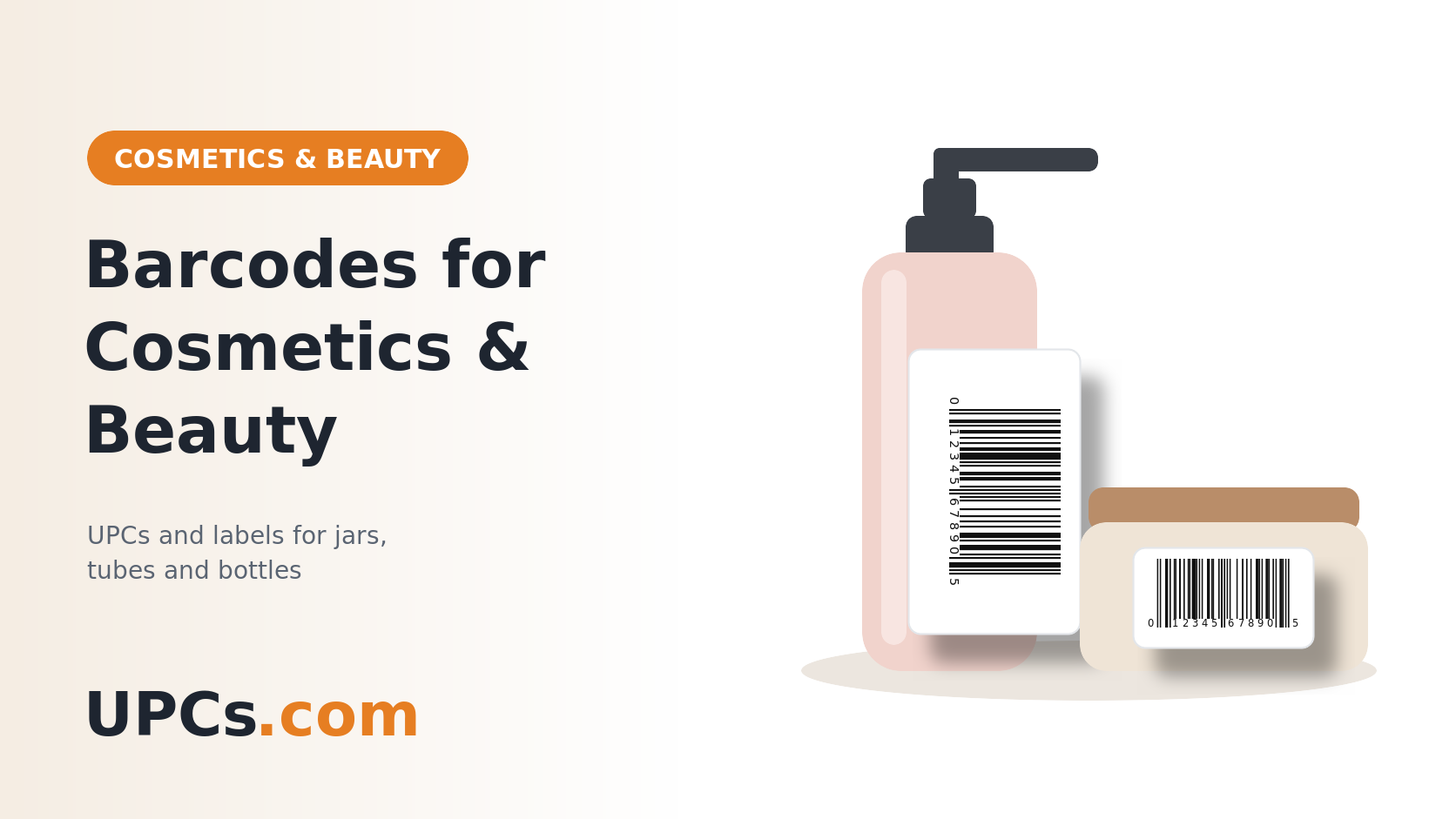 On a narrow bottle, turn the barcode so the bars run around the curve; on jars, use a flat side or the lid.
UPC vs. FDA: Who Regulates What on Your Label?
A UPC is sometimes mistaken for an FDA registration. It isn't. The required label elements and the barcode do different jobs:
| Label Element | Who Governs It | What It Does |
|---|---|---|
| Ingredient list | FDA | Lists ingredients in descending order of predominance |
| Product identity and net quantity | FDA | States what the product is and how much is inside |
| Business name and contact details | FDA (including the Modernization of Cosmetics Regulation Act, MoCRA) | Identifies the responsible company and how to report problems |
| UPC barcode | Commerce standard — not a government agency | Identifies the exact shade, scent, and size at registers and marketplaces |
So the FDA cares about what your label says, not about your barcode. Buying UPCs involves no application and no waiting — order at UPCs.com and the codes arrive by email within minutes.
How Many UPCs Does a Beauty Line Need?
One per unique sellable item. In beauty, "unique" usually means a different shade, scent, formula, or size:
| Product | Variations | UPCs Needed |
|---|---|---|
| Lipstick | 12 shades | 12 |
| Face serum | Full size and travel size | 2 |
| Body lotion | 3 scents × 2 sizes | 6 |
| Holiday gift set | Sold as one item | 1 |
| Total for the line | 4 products | 21 UPCs |
A few beauty-specific rules: minis and travel sizes each need their own code, refills are separate products from the full pack, and a gift set gets its own code even though each item inside has one. A refreshed pack design for the same product keeps its code. (The full counting method: how many UPC codes do I need?)
Solving the Small-Package Problem
Lip balm, nail polish, mascara, and sample vials rarely have room for a full-size barcode. Here's what works:
- Put the barcode on the carton. If the product is sold in a box or on a blister card, the barcode goes there — that's what gets scanned.
- Turn it on narrow tubes. Rotate the barcode 90° so the bars run horizontally around the tube. Bars that wrap across a tight curve often won't scan.
- Don't shrink below 80% or cut the height. A cropped barcode fits the space but fails at the register. (Specs: barcode files for packaging designers.)
- Use a neck tag or hang card when the item has no box and no flat surface.
Labels That Survive the Bathroom
Beauty products get wet, oily, and handled constantly. Paper labels soak up lotion and water; film labels (polypropylene or polyester) with a permanent adhesive hold up far better, and a matte finish scans more reliably than gloss under store lights. (Full comparison: which barcode label material should you use?)
Step-by-Step: Barcoding Your Beauty Brand
-
1
Map Every Shade, Scent, and Size
Build a spreadsheet with one row per shade × size (or scent × size), plus minis, refills, and sets. Give each row an internal SKU. (SKU vs. UPC: here's the difference.)
-
2
Buy Your UPCs — Once, Not Annually
Order your block at UPCs.com. You'll receive the numbers and scan-ready barcode files within minutes, and the codes are yours for the life of your brand — no renewals as your shade range grows.
-
3
Place the Barcode in Your Artwork
Send your designer the PDF barcode file for each shade along with your ingredient panel. Check that each pack carries its own code — swapped barcodes between shades are the most common beauty mistake.
-
4
Choose Labels That Last
If you label bottles yourself, use film labels. Or have us print them: printed barcode labels on rolls or sheets, shipped within 24 hours in the US.
-
5
Sync the Codes and Test-Scan
Enter each UPC in Amazon, Shopify, and your retailer paperwork, then scan a finished product with a phone app before the full production run. Selling to stores? Add SCC-14 case codes for your shipping cartons. (Amazon specifics: Amazon FBA UPC requirements.)
Frequently Asked Questions
Does the FDA require a barcode on cosmetics?
No. The FDA regulates the ingredient list, identity, net quantity, and business details on your label. Barcodes are a retail and marketplace requirement, not a government one.
Does every shade need its own UPC?
Yes. Each shade is a separate product to registers and marketplaces, and so is each size.
Do travel sizes and minis need a separate UPC?
Yes. A 15 ml travel size and a 50 ml full size are different products, so each needs its own code.
Where does the barcode go on a lipstick or lip balm?
On the outer carton or blister card if there is one. If the tube is sold loose, turn the barcode so the bars run around the tube, and keep it at 80% of standard size or larger.
Launch Your Beauty Line Right
Authentic UPC codes delivered in minutes — one for every shade, scent, and size. One price, owned forever, with no renewals as your range grows.
Buy UPC Barcodes Now