
UPC Barcodes for Clothing & Apparel: Every Size and Color, Hang Tags vs Labels
Clothing is the most barcode-hungry category in retail. A single t-shirt design can turn into two dozen sellable products once you add sizes and colors — and every one of them has to scan as itself at the register, in the warehouse, and on Amazon. So the first question every apparel founder asks is simple: how many UPC codes does my clothing line need, and where does the barcode actually go?
The direct answer: every unique combination of style, size, and color gets its own 12-digit UPC code, and on clothing that barcode usually lives on the hang tag — either printed on the tag or on a barcode label applied to it. Below we'll walk through the math with real examples, compare hang tags and labels, and show how to set up your size and color variants on Shopify, Amazon, and Walmart. UPCs.com has supplied barcodes to more than 200,000 customers since the late 1990s, and apparel lines are some of our biggest orders for exactly this reason.
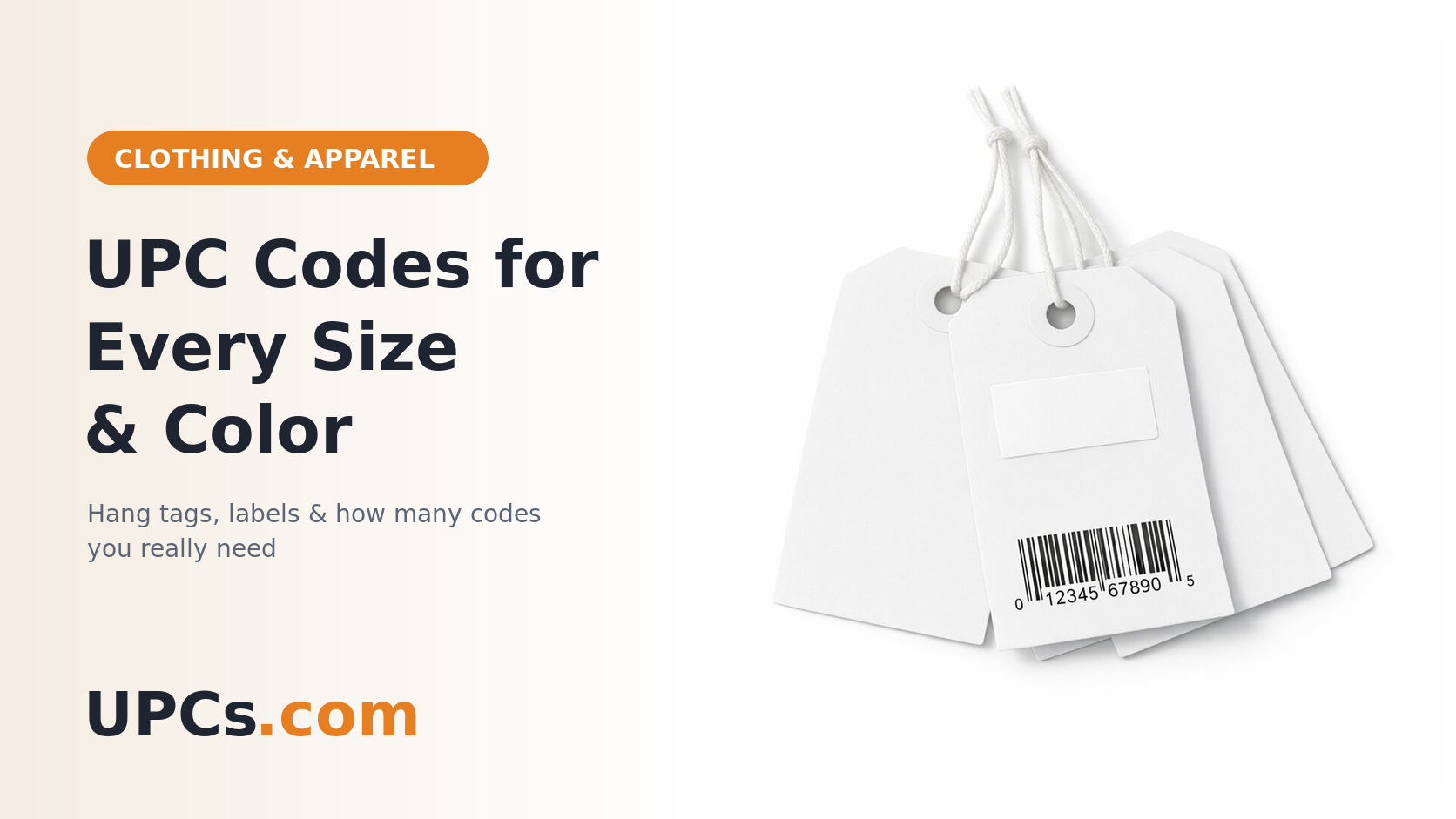 One UPC per size and color: on clothing, the barcode lives on the hang tag or on a label applied to it.
UPC vs. Care Label: Who Regulates What on Your Clothing?
New apparel brands often assume the barcode is part of the legally required labeling. It isn't. The required labels and the UPC do completely different jobs:
| Label Element | Who Governs It | What It Does |
|---|---|---|
| Fiber content & country of origin | FTC (Textile Fiber Products Identification Act) | Tells the buyer what the garment is made of and where |
| Care instructions | FTC Care Labeling Rule | Washing, drying, and ironing directions on a permanent label |
| Company name or RN number | FTC | Identifies the business responsible for the product |
| UPC barcode | Commerce standard — not a government agency | Identifies the exact style, size, and color at registers and marketplaces |
That's why the UPC doesn't belong on the sewn-in care label. The care label has to stay on the garment for its whole life, and a barcode printed on fabric wrinkles and won't scan reliably. The UPC goes on the removable hang tag or on the packaging instead. (New to the terminology? Start with GTIN vs. UPC explained.)
How Many UPC Codes Does a Clothing Line Need?
One per unique sellable item. For apparel, "unique" means a different style, size, color, or pack count. Multiply your sizes by your colors for each style, then add any multipacks:
| Product | Variations | UPCs Needed |
|---|---|---|
| Logo t-shirt | 4 colors × 6 sizes (XS–XXL) | 24 |
| Hoodie | 3 colors × 5 sizes (S–XXL) | 15 |
| Socks 3-pack | 2 colors × 3 sizes | 6 |
| Baseball cap | 3 colors, one size | 3 |
| Total for the line | 4 products | 48 UPCs |
Four products, 48 barcodes — and that's a small launch. Here's what does and doesn't need a new code:
- New UPC: a new color or seasonal colorway, a new size, a new fit or cut (slim vs. relaxed), a multipack or gift set, and any new style.
- Same UPC: restocking the same item, reprinting its hang tags, and selling it on several channels (your store, Amazon, a boutique). One product keeps one code everywhere.
Plan for growth when you buy. Apparel lines add colorways every season, and our codes never expire, so buying a block of 100 up front costs less per code than buying 10 at a time and keeps your numbering tidy. (The complete rule set: Do I need a separate UPC for every product?)
Hang Tags vs. Barcode Labels: Where the UPC Goes on Clothing
There are three common ways to put the barcode on a garment. Most growing brands end up using the second one:
| Method | Best For | Watch Out For |
|---|---|---|
| Barcode printed directly on the hang tag | Large runs of a few best-selling items | Every size and color needs its own tag print run — 48 tag versions for the line above |
| One branded hang tag + a barcode label | Most small and growing brands | Leave a clear white space on the tag for the label |
| Barcode label on the polybag or box | Online orders, socks, underwear, and multipacks | Amazon FBA may want its own FNSKU label as well |
The branded-tag-plus-label approach is popular for a reason: you design and print one hang tag for the whole collection, then apply a small barcode label for each size and color. When you add a colorway, you only need new labels — not a new tag print run. The white box on the tags in the image above is exactly that space.
If you ship through Amazon FBA, Amazon may ask you to cover the manufacturer barcode with an FNSKU label on the bag, so each unit is tracked to your seller account. (Details: Amazon FNSKU: everything you need to know.)
Print the Size and Color Next to the Barcode
A scanner reads the UPC, but the person picking an order in your stockroom can't. Always print the style, size, and color in plain text next to the barcode (for example, "Logo Tee – Black – M"). It prevents the most common apparel mistake of all: the right shirt in the wrong size.
- Size: a standard UPC is about 1.47" × 1.02" at full size. You can shrink it to 80%, but don't go smaller, and don't cut the bars shorter to fit a small tag. A 1.5" × 1" label holds a standard UPC; a 1.5" × 1.5" label leaves room for a line of size and color text underneath.
- Quiet zones: keep a clear white margin on both sides of the bars, and don't let the tag's hole punch or string cross the barcode.
- Color: black bars on a white background. Kraft-paper and dark tags look great but often won't scan, which is another reason to put the barcode on a white label.
(Specs and examples: barcode sizing and placement and why a barcode won't scan.)
Setting Up Size and Color Variants Online
Your UPCs only work if every channel knows which code belongs to which variant:
- Shopify: each variant has its own "Barcode (ISBN, UPC, GTIN, etc.)" field. Enter one UPC per size-and-color variant.
- WooCommerce: each variation of a variable product has its own GTIN/UPC field (WooCommerce 9.2 and later). (Store setup: barcodes for Shopify, Etsy, and WooCommerce.)
- Amazon: clothing is listed as a variation family. The parent listing groups your sizes and colors and doesn't take a UPC, but every child variation needs its own. (More: UPC codes for Amazon.)
- Walmart: every variant item needs its own UPC. (See common Walmart UPC errors.)
- TikTok Shop: the product ID field is optional in most US categories, but adding one UPC per variant helps catalog matching and keeps your codes consistent across channels. (More: TikTok Shop UPC requirements.)
Etsy doesn't require barcodes, but if you also plan to sell on Amazon, Walmart, or through boutiques, assign codes now so each item keeps one UPC across every channel.
Step-by-Step: Barcoding Your Clothing Line
-
1
Build Your Size and Color Matrix
Make a spreadsheet with one row per style × color × size, plus any multipacks. Give each row an internal SKU. This is the list your UPCs will be assigned to. (SKU vs. UPC roles: here's the difference.)
-
2
Buy Your UPCs — Once, Not Annually
Order your block at UPCs.com. You'll receive the numbers, scan-ready barcode graphics, and a certificate of ownership within minutes. The codes are a one-time purchase you own for the life of your brand — no renewals, even in a slow season. (Details: Will my UPC codes ever expire?)
-
3
Assign Codes in a Logical Order
Work through your codes in order — for example style by style, then color, then size — and record each one in your spreadsheet. Never move a code to a different product later; a UPC should always mean the same item.
-
4
Print Your Labels or Tags
For your best sellers, order printed barcode labels on rolls or sheets with the size and color printed right on the label. Each order is 1,000 labels of one code and ships within 24 hours in the US. For a full size run, send us a spreadsheet of codes and label text and we'll quote it. Printing yourself? Start with blank label tags and our guide to printing barcode labels at home. (Choosing a format: rolls vs. sheets.)
-
5
Enter the Codes Everywhere and Test-Scan
Add each UPC to its variant in Shopify, Amazon, Walmart, and your inventory system. Then scan a finished tag with a phone app and check that it matches the right size and color in your spreadsheet before you tag the whole shipment. (Also: common printing mistakes to avoid.)
Frequently Asked Questions
Do I need a different UPC for each size?
Yes. A medium and a large are different products to every scanner and marketplace, so each size needs its own code. The same goes for every color.
Can I use one UPC for a whole style?
No. If one code covered every size and color, registers and marketplaces couldn't tell the variants apart, and your inventory counts would be wrong. Every sellable variation needs its own UPC.
Does a multipack need its own UPC?
Yes. A 3-pack of socks is a different product from a single pair, so it gets its own code — even if each pair inside also has one.
Do I need new UPCs when I reorder the same item?
No. Restocking the exact same style, size, and color keeps the same UPC. Only a new variation needs a new code.
Do I need a UPC to sell clothing on Etsy or my own website?
Not for Etsy or your own site, and a UPC is optional in most TikTok Shop categories. Amazon (unless you have a GTIN exemption), Walmart, and most retail stores do require one. Assigning codes from day one saves you from re-tagging inventory later.
Barcode Your Whole Clothing Line
Authentic UPC codes delivered in minutes — one for every size and color, owned forever with no renewals. Need them on labels? We print and ship within 24 hours.
Buy UPC Barcodes Now